Aleš Veselý: Aleš Veselý (1935 - 2015) - BEZ NÁZVU
pencil, mud, acrylic, canvas The work of Aleš Veselý (1935–2015) occupies a truly exceptional position in the context of Czech art, primarily thanks to his ability to combine, in monumental forms, the most fundamental questions about the essence of phenomena and events with an intrinsically intimate experience. As a result, his paintings, drawings, and objects, which straddle the boundary between sculpture and architecture, resonate not only with the archetypal and mythical ideas of humanity and the ideas of Eastern philosophies, but also with the findings of modern relativistic physics. Many of the ideas that define the fundamental character of Veselý's thinking can already be found in the poetic-theoretical text Usurpator, or Auxiliary Text for Defining a Delimited Space (1966), which the artist formulated in connection with the object Chair Usurpator (1964). In the text, Veselý moves toward a conception of time and space close to archaic cosmological ideas and to an order of the world in which the boundaries between microcosm and macrocosm and between subject and object are blurred. The exploration of the laws of natural forces in an endless process of change and the latent manifestations of energy between individual elements subsequently became a continuously developed theme in Veselý's work, which draws man into the cosmic cycle with its complex, universally valid principles. It is from this perspective that we should view not only the utopian desert and landscape projects and projects of "anthropometric places," through which Aleš Veselý ranked himself alongside the great figures of world land art and earth art, but also his monumental paintings from the 1980s. The expressive drawings in acrylic paint on canvas or paper, which Veselý called "drawing-paintings," cannot be understood merely as an immediate expression of the author's heightened sensibility, but also herald his unique conception of the universe. If everything in the structure of the world is interconnected and subject to the same principles, then the artist's deep spiritual immersion becomes a direct condition for approaching the universal themes of order and chaos – "if a work is not strongly motivated subjectively, it is very difficult for it to touch on objective major themes." That is why the energetically thrown lines on paper form mysterious spherical elements connected by a rope or spring. A similar pictorial scheme, to which Veselý later returned many times, first appeared in his sculpture Memento, which was created at the same time as the famous sculpture Kaddish at the Symposium of Spatial Forms in Ostrava (1967–1968). While in Memento a massive sphere is suspended on a triangular structure and prevented from falling to the ground by a rope, in the paintings from the 1980s it is not entirely clear whether the spherical mass is attracted to the ground or whether we are witnessing a collision of elements or the expansion of planetary bodies. The vanishing points place the viewer at the foot of the scene, who at the same time finds himself in the position of the author and, together with him, becomes a direct participant in the force of action. The mutual relations between the elements are not only determined by the compression and tension of springs, but also by the latent forces that arise between material bodies and which are multiplied and condensed here. The pressure and weight of the mass, recorded in an energetic expression, are almost tangible. The series of "drawings-paintings," begun in 1984, was completed two years later during the artist's three-month scholarship stay in the USA, which Veselý perceived as a key period. The powerful experience of the "big space and big sky" across the ocean transformed his work in a constructive and rational direction. The spontaneity and exuberance of his nervous expression receded, but the intuitive awareness of connections and the duality of universal principles remained permanently present in Aleš Veselý's work. • Martina Mrázová
Další z ETCETERA ART s.r.o.
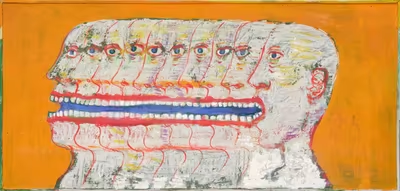 2 150 000 KčJiří Sopko: Jiří Sopko (1942) - BEZ NÁZVU (VELKÝ ÚSMĚV/DESET HLAV)
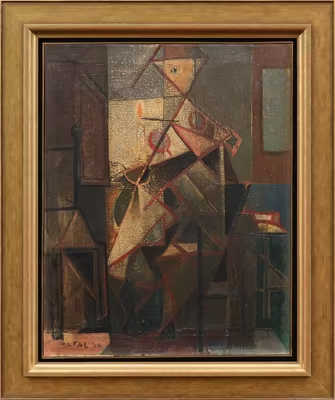 1 000 000 KčBohumír Matal: Bohumír Matal (1922 - 1988) - MALÝ CHLAPEC SE SVÍČKOU
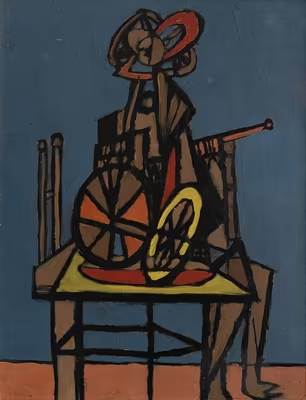 800 000 KčFRANTIŠEK GROSS: FRANTIŠEK GROSS (1909–1985) - FIGURA
 600 000 KčJan Merta: Jan Merta (*1952) - ŠPINAVÝ SNÍH (SNĚHULÁK Z BRNA)
 600 000 KčJan Hísek: Jan Hísek (*1961) - VOLAVKA
 500 000 KčKarel Malich: Karel Malich (1924–2019) - SVĚTLO VE MNĚ